
How are Dressage Tests Scored?
Every test has an associated score sheet with a series of boxes, where the judge assigns a score and often a comment for the movement performed. There are also five marks given at the end of each test called the Collective Marks: Gaits, Submission, Impulsion, Rider’s Seat and Position, and Rider’s Correct and Effective Use of Aids. Some of the test movements and Collective Marks have coefficients associated with them which means they are worth two times the points assigned. (USDF)
Each movement is scored on a scale of 0 (not performed) to 10 (excellent) (USDF). The scores can be whole numbers (i.e., 6.0) or have a half score (i.e., 6.5). Scores of 6.0 and 6.5 are the most common in USEF/USDF and schooling shows, although higher and lower scores are certainly seen.
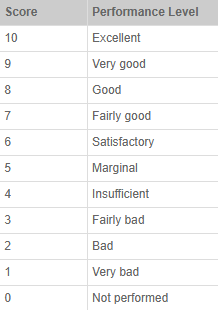
Using the same 0 – 10 scoring, the collective marks are evaluated as follows:
- Gaits: The freedom and regularity.
- Impulsion: Desire to move forward, elasticity of the steps, suppleness of the back, engagement of the hindquarters.
- Submission: The horse’s attention and confidence, lightness and ease of movements, acceptance o the bridle, lightness of the forehand and straightness.
- Rider’s position and seat.
- Rider’s correctness and effect of the aid.
Click here for more information on the USDF website.
Click here to Return to FADS Showing Information Table of Contents.