

TABLE OF CONTENTS
- INTRODUCTION
- TERMINOLOGY
- YOUR SUPPORT TEAM
- SCHOOLING SHOWS VS. USEF LICENSED / USDF RECOGNIZED SHOWS
- READ THE USEF RULE BOOK
- WHAT ARE YOUR COMPETITION GOALS?
- WHAT ARE DRESSAGE LEVELS?
- WHAT ARE DRESSAGE TESTS?
- WHAT IS A DRESSAGE ARENA?
- HOW ARE DRESSAGE TESTS SCORED?
- WHICH DRESSAGE TEST(S) SHOULD YOU RIDE IN A SHOW?
- HOW MANY TESTS SHOULD YOU RIDE IN A SHOW ON THE SAME HORSE?
- WHICH SHOW(S) SHOULD YOU RIDE IN?
- WHAT IS A PRIZE LIST?
- WHAT IS AN OPENING DATE?
- WHAT IS A CLOSING DATE?
- SHOULD I ENTER A SHOW NEAR THE OPENING DATE OR THE CLOSING DATE?
- WHAT IS A LATE ENTRY?
- WHAT IS A COGGINS?
- WHAT IS A CERTIFICATE OF VETERINARY INSPECTION?
- WHAT IS A WAIVER?
- WHAT IS A SCRATCH?
- RIDER ATTIRE AND HORSE EQUIPMENT
- HOW TO ENTER A FADS SHOW
- LEARN YOUR TEST(S)
- PREPARE YOUR HORSE
- PREPARE YOUR TRUCK AND HORSE TRAILER
- PACK YOUR SHOW ITEMS
- PREPARE YOUR SHOW DAY SCHEDULE
- ARRIVE AT THE SHOW GROUNDS
- CHECK IN AT THE SHOW OFFICE
- WARM-UP YOUR HORSE
- ARRIVE AT THE SHOW ARENA ON TIME
- AFTER THE JUDGE MAKES A NOISE, ENTER THE ARENA AT A
- RIDE THE TEST
- A CALLER (PERSON READING THE TEST) IS ALLOWED
- COACHING DURING THE TEST IS NOT ALLOWED
- ERRORS WHILE RIDING A TEST IN A SHOW
- IN THE ARENA – AFTER YOU COMPLETE YOUR TEST
- OUTSIDE THE ARENA – AFTER YOU COMPLETE YOUR TEST
- GET TEST SHEET AND RIBBON FROM SHOW OFFICE
- REVIEW YOUR TEST SHEET BEFORE YOU DEPART
- DEPART THE SHOW AND DRIVE HOME
- AFTER YOU ARRIVE HOME
Deciding to ride in a show, whether it be your first show or your nth show, is exciting. You have many decisions to make including preparation of you and your horse, what type and which show to attend, etc. I hope this section of the FADS website will assist you in your showing adventure.
Click here to Return to Table of Contents
- Fédération Equestre Internationale (FEI): The international governing body of equestrian sports. It is responsible for drafting and enforcing international rules for international shows for dressage and para-dressage, driving and para-driving, endurance, eventing, show jumping, and vaulting. International competition is very expensive. Click here to open the FEI website.
- US Equestrian (USEF): The US national governing body responsible for drafting and enforcing US national rules for 27 equestrian disciplines. Click here to open the USEF website.
- United States Dressage Federation (USDF): The US national membership federation for the equestrian sport of dressage. It is committed to education, recognition of achievement, and promotion of dressage in the US. Click here to open the USDF website.
- USEF Licensed / USDF Recognized Shows (USEF/USDF Shows): US national dressage shows sanctioned by the USEF and USDF. The shows follow USEF rules and USDF guidelines. National competition is expensive. Click here for further information on the FADS website.
- Schooling Shows: Dressage schooling shows are local shows that are not directly governed by the FEI, USEF, or USDF; however, these shows usually follow USEF rules, with some exceptions. These shows are inexpensive and may serve as a stepping stone toward national or international shows, or may be a rider’s exclusive showing experience. All FADS shows are dressage schooling shows.
- Concours de Dressage Shows (CDI): International shows governed by the FEI.
- Show Manager: The horse show manager is the person responsible for the overall organization, coordination, and administration of a horse show.
- Show Secretary: The horse show secretary is the person who is responsible for receiving, processing and get corrections for show entries. The show secretary schedules the show and produces documents for the show such as an order of go list and results list.
Click here to Return to Table of Contents
Your showing experience will be enhanced if you build a loyal and knowledgeable support team. This can include your trainer, barn mates, friends, family, etc. Listen to their advice but make your own decisions. Decide who will accompany you to the show – it is best to have at least one show-day helper but too many people can be an unruly crowd!
Click here to Return to Table of Contents
SCHOOLING SHOWS VS. USEF LICENSED / USDF RECOGNIZED SHOWS:
US dressage shows may be schooling shows or national USEF/USDF shows.
Schooling shows are local shows that may be sponsored by a club, a farm, etc. They may strictly follow USEF rules and USDF guidance, or they may follow them less strictly. Schooling shows usually have minimal, if any, membership requirements for people or horses and are less expensive.
USEF/USDF shows are US national shows that strictly follow USEF rules and USDF guidance. They require memberships for riders, owners and trainers and USEF recordation / USDF registration of the horse. USEF/USDF shows are expensive.
Click here for more information on the FADS website.
Click here to Return to Table of Contents
USEF publishes rules that apply to USEF/USDF (and other) (national) shows. Click here for links to the rules. Even if you are not riding in USEF/USDF shows, it is a good idea to know these rules. Schooling shows, including FADS shows, usually follow the rules, with a few exceptions. A good rule of thumb is to assume a schooling show follows the USEF rules; if you have a question regarding the schooling show and rules, contact the show’s management.
Click here to Return to Table of Contents
WHAT ARE YOUR COMPETITION GOALS?
Different riders have different showing goals:
- INTERNATIONAL GOALS: A few riders endeavor to ride in CDI (FEI) shows and qualify for exclusive international shows, including the Olympics. They may initially ride green horses in USEF/USDF shows or schooling shows as this gives the horse (and rider) showing experience before hitting the very expensive “big time.”
- NATIONAL GOALS: Some riders want to ride in USEF/USDF shows and compete for associated local and national awards. They may initially ride green horses in schooling shows as this gives the horse (and rider) showing experience before riding in the expensive national shows.
- SCHOOLING SHOW GOALS: Many riders do not have international or national goals; they want to learn and have fun (and save money!) at dressage schooling shows. FADS shows are this type of show.
Riders can also have different goals for different horses.
First determine your goals, then select shows that are appropriate for you. Starting with schooling shows, including FADS shows, will help you determine if you can ultimately ride in USEF/USDF and CDI shows while letting you have fun and save money.
Click here to Return to Table of Contents
Dressage levels classify the progression of horse and rider training, ranging from basic to advanced advanced movements. Each level represents an increasing difficulty.
In the US, the following are the USEF/USDF dressage levels: (click here for reference)
- Introductory Level: This is the starting point for many riders, focusing on basic movements such as walk and trot. The emphasis is on establishing a rhythm and balance without cantering.
- Training Level: At this level, riders begin to introduce canter work and more complex patterns, such as 20 meter circles. The goal is to develop the horse’s responsiveness and ability to maintain a steady rhythm.
- First Level: This level builds on the basics, requiring improved balance and thrust. Riders will perform movements like leg yielding and transitions, focusing on the horse’s impulsion and straightness.
- Second Level: Here, riders and horses are expected to demonstrate more advanced movements, including increased collection and lateral work. The tests become more challenging, requiring a higher level of skill and coordination.
- Third Level: This level introduces more complex movements, such as flying changes and advanced lateral work. Riders must show a strong connection with their horse and execute movements with precision.
- Fourth Level: At this advanced level, riders and horses perform intricate movements that require a high degree of training and skill. The focus is on achieving a high level of collection and refinement in the horse’s movements.
- FEI Levels: These are the highest levels of dressage, including tests like Prix St. Georges, Intermediaire, and Grand Prix. These levels are recognized internationally and require exceptional skill and training.
There are additional USDF tests, FEI tests, and USEA (eventing) tests. Click here for more information on the FADS website.
Eventing levels are USEA starter, USEA beginner novice, USEA novice, USEA training, USEA modified, USEA preliminary, USEA intermediate, USEA advanced, and FEI.
Click here to Return to Table of Contents
- Each USEF/USDF level has three tests. The nomenclature is X Level Test Y; for example, First Level Test 2.
- Dressage tests are structured sequences of horse riding movements performed in a standard-sized arena (60m x 20m or 40m x 20m), designed to assess the skill, obedience, and training progress of both horse and rider. Each movement is scored by the dressage judge.
- Dressage tests are primarily a tool to measure the horse and rider’s schooling and training progress. Each tests represents a level of difficulty, and the skills gradually build up from beginner to advanced levels. Performing these tests helps ensure that horses develop fundamental abilities like balance, rhythm, suppleness, and responsiveness to the rider’s aids, while riders learn precision, timing, and effective communication with their horse. (USEF)
- 2023 Intro – Fourth Level Test Diagrams (link to web site) – Click here (diagrams developed by Alison May – posted with permission)
- Explanation of USEF Dressage Test Sheets – Training through Fourth Levels (download PDF file) – Click here
- Explanation of USDF Dressage Test Sheets – Introductory Level (download PDF file) – Click here
USEA (eventing) starter level has one test. The other USEA levels have three tests each. FEI has many dressage tests (click here).
Click here to Return to Table of Contents
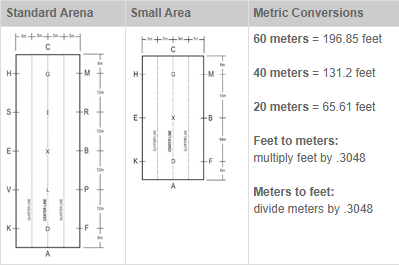
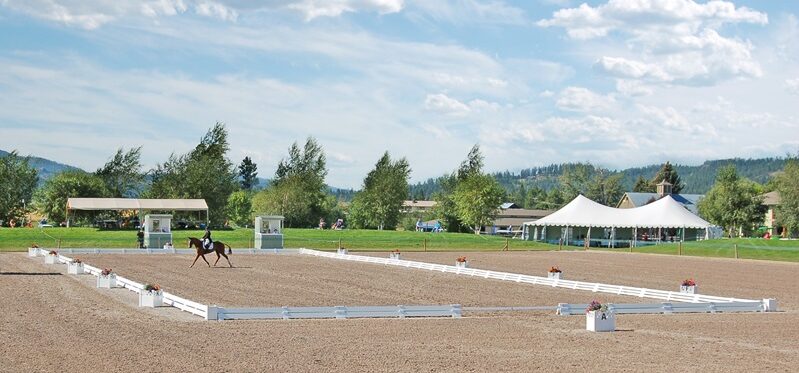
Dressage tests are ridden in an arena that is either 20m x 60m (standard or large arena) or 20m x 40m (small arena). They have letters that that mark certain points of the arena. The letters determine the location of dressage test movements. For most shows, one judge is located at letter C. In some shows, there are multiple judges at multiple letters. (USDF)
USDF Introductory level tests and USEF training level tests may be ridding in a small or a standard (large) arena. All other USEF/USDF tests are ridden in a standard (large) arena.
USEA (eventing) starter through training level tests are usually ridden in a small (20m x 40m) arena, although many schooling shows have them in a standard/large (20m x 60m).
HOW ARE DRESSAGE TESTS SCORED?
Every test has an associated score sheet with a series of boxes, where the judge assigns a score and often a comment for the movement performed. There are also five marks given at the end of each test called the Collective Marks: Gaits, Submission, Impulsion, Rider’s Seat and Position, and Rider’s Correct and Effective Use of Aids. Some of the test movements and Collective Marks have coefficients associated with them which means they are worth two times the points assigned. (USDF)
Each movement is scored on a scale of 0 (not performed) to 10 (excellent) (USDF). The scores can be whole numbers (i.e., 6.0) or have a half score (i.e., 6.5). Scores of 6.0 and 6.5 are the most common in USEF/USDF and schooling shows, although higher and lower scores are certainly seen.
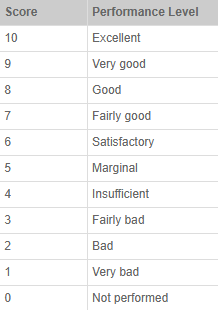
Using the same 0 – 10 scoring, the collective marks are evaluated as follows:
- Gaits: The freedom and regularity.
- Impulsion: Desire to move forward, elasticity of the steps, suppleness of the back, engagement of the hindquarters.
- Submission: The horse’s attention and confidence, lightness and ease of movements, acceptance o the bridle, lightness of the forehand and straightness.
- Rider’s position and seat.
- Rider’s correctness and effect of the aid.
Click here for more information on the USDF website.
Click here to Return to Table of Contents
WHICH DRESSAGE TEST(S) SHOULD YOU RIDE IN A SHOW?
Consult with your trainer/coach to determine which test(s) you should ride in a show.
Very often, the showing level is one level below the home (training) level. So, if you are training at first level at home, you will probably want to ride training level at a show.
Another guideline is based on your scores in previous shows. If you are consistently getting 65% or above at shows at a level, it is probably time to show at the next level.
Above all, do what is best for your horse (and you). If you are struggling at home at a level or a test, do not show at that level/test until you have comfortably resolved the issues.
Click here to Return to Table of Contents
HOW MANY TESTS SHOULD YOU RIDE IN A SHOW ON THE SAME HORSE?
USEF rule DR 119.2 states “Horses … are limited to a maximum of three Dressage rides per day at Fourth Level and below or two Dressage rides per day above Fourth Level. Horses competing at both Fourth Level and Prix St. Georges, or their equivalents, are limited to two Dressage rides per day. …”
To ensure humane treatment of horses, most FADS shows follow this USEF rule. In some FADS shows, a horse may perform four leadline and/or introductory level (only) rides under two or more riders, with rest time between the riders (about one hour is suggested). This may may be allowed for a family horse or a school horse owned by a trainer with two or more students at the show riding only leadline and/or introductory level tests.
In most cases, a horse is only ridden in two tests in a show.
If you have any questions regarding the rule for your situation at a particular FADS show, contact the FADS show manager or show secretary.
Click here to Return to Table of Contents
WHICH SHOW(S) SHOULD YOU RIDE IN?
Consult with your trainer/coach to determine which show(s) you should ride in, including if you should ride in a USEF/USDF show or a schooling show.
Sponsors of multiple shows often have an omnibus, which is a listing of all their shows with information on how to enter each show. The FADS website has a listing of each show in a show season, with links to each show;s information and a form to enter the show (click here for the 2026 shows or click YYYY SHOW LIST in the menu where YYYY is the c urrent year).
Each show usually has a prize list, which provides the details of the show and how to enter the show.
Click here to Return to Table of Contents
A prize list is a document released by a show’s management that provides information about the show, such as dates, classes, rules and regulations, judges and other officials, entry information, awards and prizes, maps of the venue, directions to the venue, special events, etc.
USEF/USDF show prize lists can be +/- 20 pages as there are many items required by USEF and USDF and the shows are larger and more complex than schooling shows.
Schooling shows prize lists are often one or two pages as there are minimal requirements.
Read the prize list in detail before entering the show as it will provide show procedures and answer most of your questions.
Click here to Return to Table of Contents
For a dressage show, the opening date is the first date the show secretary will accept show entries. The date is published in the prize list and webpage. Do not enter a show before the opening date as your entry may get lost.
Click here to Return to Table of Contents
For a dressage show, the closing date is the date after which the show secretary will (usually) not accept entries. If the show fills before the closing date, the show will close early. If the show does not fill by the closing date, it may be extended a few days to get more entries.
Most FADS shows can take a limited number of rides. For example, if a farm has one show arena, when a full day of rides has been entered in the show, no more rides can be accepted, and the show is closed. This can occur BEFORE the closing date. Therefore, a show might close before the closing date. If you really want to participate in the show, it is best to NOT wait for the closing date to enter the show.
Click here to Return to Table of Contents
SHOULD I ENTER A SHOW NEAR THE OPENING DATE OR THE CLOSING DATE?
If you really want to be in the show, enter on (or close to) the opening date. This makes you more likely to get into the show if it fills early so closes early.
If you are not desperate to be in the show, consider entering it on (or just before) the closing date. If the show fills early so closes early, you may not get in, but then you were not desperate to show.
Click here to Return to Table of Contents
A late entry is an entry that you want to submit after the show’s closing date.
Dressage shows are scheduled after the closing date – each ride is scheduled at a specific time with no extra time between the rides.
If you want to enter a show after the closing date but before scheduling, contact the show secretary to find out if you can enter.
If you want to enter a show after it has been scheduled, you can only be scheduled at the end of the show (if there is time) or to fill appropriate scratches:
- If you are scheduled at the end of the show, all the other riders in the class must wait for your ride to finish before they know the results and can get their ribbons. This is not fair to these riders who entered on time, nor is it fair for the horses who may have to wait a long time in trailers. Some shows will schedule late entries at the end of the show, if there is time, as HC rides (the rider rides before the judge and a scoresheet is completed but the ride is not part of a class, and the rider is not awarded a place or a ribbon). If you want to enter a show after it is closed, ask the show secretary if you can enter HC.
- Some shows will put late entries on a wait list to be used if there are scratches in the applicable class(es). If you want to enter a show after it is closed, ask the show secretary if you can be put on a waiting list to fill scratched rides. Filling scratches can be difficult as the new ride must be the same duration (minutes provided for the test in the show schedule) and must not inconvenience other riders (if the scratch is later than the balance of the class, putting a new class rider in the show will inconvenience the class riders).
USEF/USDF shows often charge a late entry fee. Schooling shows usually do not charge a late entry fee. Look for information in the prize list, or email the show secretary, for late entry policies.
Click here to Return to Table of Contents
The Coggins is a test for Equine Infectious Anemia, or EIA. This is a deadly infectious disease of horses for which there is no cure. Click here for more information from the Merck Veterinary Manual. The Coggins test is a blood test done on horses yearly. The owner receives, usually via email, a certificate that the horse tested negative for EIA. The certificate must accompany the horse anytime he/she leaves the property, including going to shows.
Always have a copy of the Coggins test any time your horse is trailered.
For shows, you must provide a copy of the Coggins test via uploading the file as part of the show entry, emailing the file to the show secretary, or bringing the document to the show. Check the prize list for the show’s Coggins policies.
Click here for further information and the Maryland law regarding Coggins tests.
Click here to Return to Table of Contents
WHAT IS A CERTIFICATE OF VETERINARY INSPECTION?
A Certificate of Veterinarian Inspection (CVI) is a document ensuring a horse has recently been evaluated by a veterinarian for signs of illness.
A CVI is required for some travel and helps reduce disease spread by stopping transport of sick horses.
Except for circumstances where a disease is spreading in the area, the document is not required for horses from Maryland, Delaware, Pennsylvania, Virginia, and West Virginia. Click here for further information and the Maryland Law regarding CVI.
For shows, refer to the prize list to determine CVI policies.
Click here to Return to Table of Contents
A Waiver (Hold Harmless Agreement, Release of Liability, etc.) is a legal document that protects one party from liability for injuries or damages that may occur during a service or activity provided by another party. It ensures that the service provider cannot be held legally responsible for any risk incurred.
Property owners that allow equine activities on their property require participants to sign a waiver.
Maryland does not have an equine immunity statute, which means that horse owners and operators are not protected from liability for injuries caused by the inherent risks of equine activities. The state uses the contributory negligence standard to determine damages, meaning that if a plaintiff’s own negligence contributes to their injury, they may not recover any damages. Maryland’s approach to equine liability is based on the legal doctrine of assumption of risk, which applies to all individuals who come into contact with horses.
FADS does not have a generic waiver for all FADS shows. Instead, each show management has their own waiver form that must be signed before a rider can participate in a show. For shows, you must provide a copy of the show’s waiver form via uploading the file as part of the show entry, emailing the file to the show secretary, or bringing the document to the show. Check the prize list for the show’s waiver document and policies.
Click here for details on equine liability in Maryland, as published by the Maryland Horse Council (July 17, 2018).
Click here to Return to Table of Contents
Sometimes, after you enter a show, you find out you cannot attend. You contact the show secretary to let her know you must scratch your rides.
If you scratch BEFORE the show closes:
- For schooling shows, you usually are not charged any fees. Check the prize list for scratch policies.
- For USEF/USDF shows, you usually are charged the office fee but other fees are refunded. Check the prize list for scratch policies.
If you scratch AFTER the show closes:
- For schooling shows, you usually do not receive a refund of show fees. Check the prize list for scratch policies.
- For USEF/USDF shows, you usually do not receive a refund of any fees. Check the prize list for scratch policies.
Click here to Return to Table of Contents
RIDER ATTIRE AND HORSE EQUIPMENT
Rider Attire:
For USEF/USDF shows, rider attire is governed by USEF Rule DR120 Dress. The chapter covers riding coats, shirts, breeches, boots, gloves, whips, rain hat covers, rain wear, spurs, cooling vests, and logos on jackets, etc. For details click here, then look at rule 120.
FADS shows are casual – formal dressage rider attire is not required; however, a rider may wear formal dressage rider attire if desired. In all FADS shows, riders must wear an approved safety helmet with the harness fastened and riding-safe footwear with heels. FADS riders are expected to wear attire that is respectful of the judge, including shirts with sleeves and no T-shirts.
Horse Equipment:
For USEF/USDF shows, horse equipment is governed by USEF Rule DR121 Saddlery and Equipment. The rules provide for standardization (thereby avoiding unfair competitive advantage), humane management of the horse, and safety. The horse equipment rule covers saddles, saddle pads, logos on saddle pads, bits, bridles, the fit of bridles, prohibited equipment, ear covers, breast plate, crupper, reins, false tails, decorations, braiding of mane and tail, side reins, equipment allowed in warm-up, lunging equipment, whips, and bridle numbers. For details, click here to open the USEF rules page, then click the DR Dressage Division box, then look at rule 121.
FADS shows do not conduct equipment inspections; however, if a show official notices inhumane or dangerous equipment, the rider may be asked to change the equipment. Therefore, it is a good idea for schooling show riders to follow the USEF rules. Additionally, most judges at FADS shows require adherence to the USEF equipment rules.
The following links provide information for rider attire and horse equipment:
- USEF Dressage Attire and Equipment: This official USEF PDF document is a booklet with the details of rider attire and horse equipment for licensed shows. Click here to download the document.
- USEF Dressage Chapter DR 121 Annex A – Bits, Saddlery, and Equipment: This official USEF PDF document shows what bits are allowed in USEF and FEI licensed shows. Click here to download.
NOTE: Attire and equipment rules change frequently; therefore, always refer to an online reference.
Click here to Return to Table of Contents
1. Look at the FADS Show List on the FADS Website:
On the top menu of the FADS website home page, click on the YYYY SHOW LIST menu item, where YYYY is the current year.
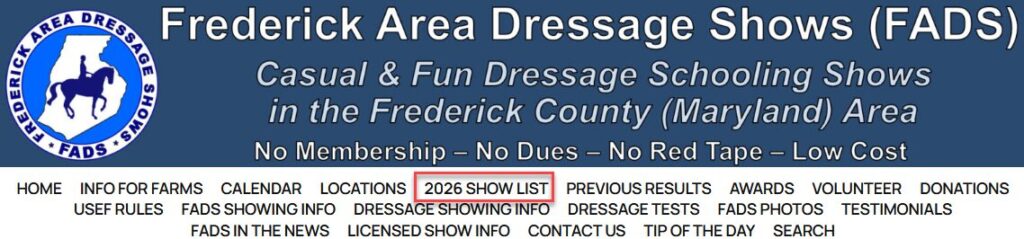
The YYYY SHOW LIST opens.
Read NOTES FOR RIDERS / OWNERS / TRAINERS.
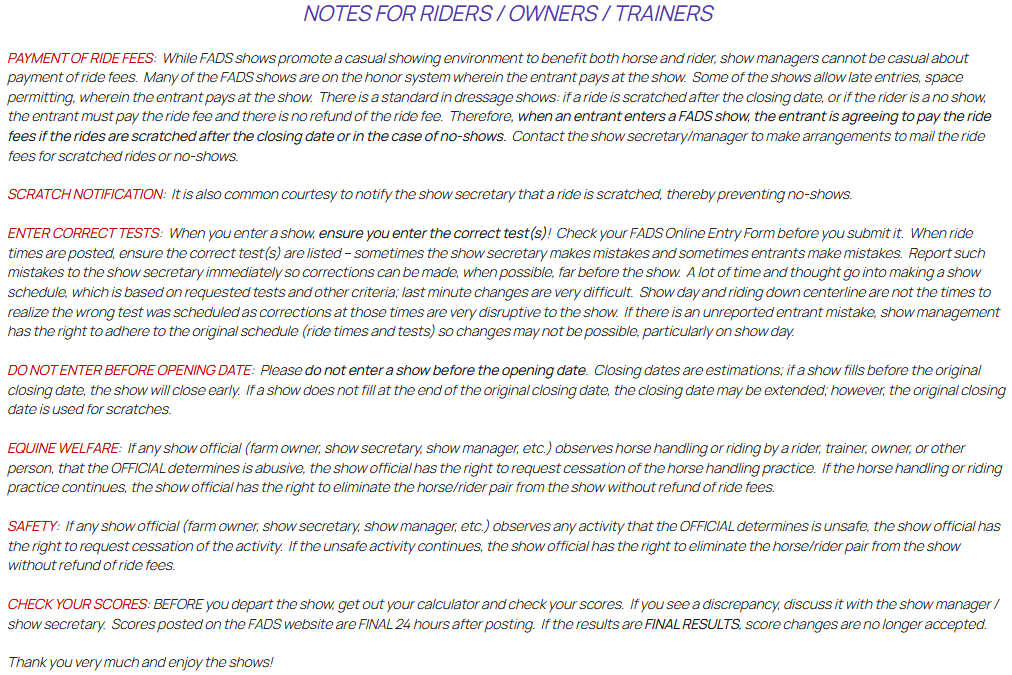
2. Open the Show’s Webpage:
From the YYYY SHOW LIST, under the category SHOW NAME, click the name of the show you want to enter.
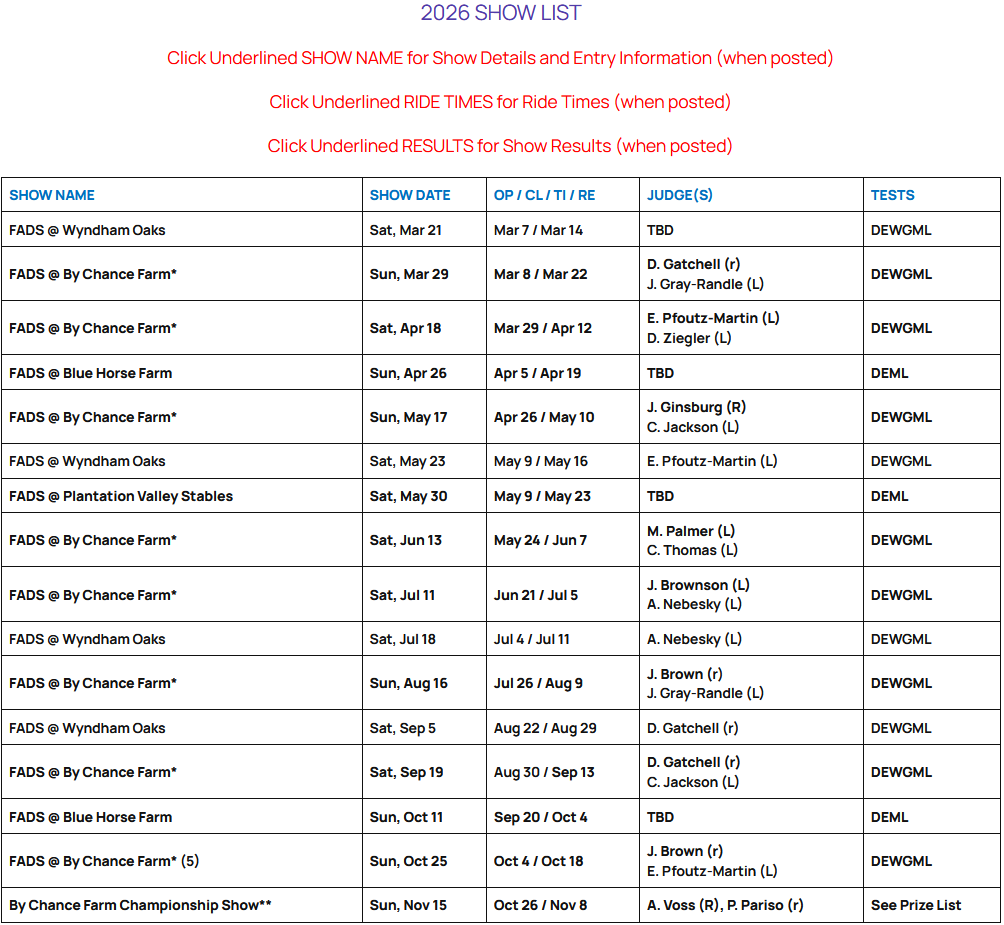
3. Read the Show’s Webpage.
The show’s webpage opens.
ENTER SHOW PAGE GRAPHIC HERE.
Check to ensure you opened the correct show.
Read the information on the show’s web page to ensure this is a show in which you can/want to compete. Note the following:
- Show Date: Is this a date you can attend a show?
- Opening Date: Do not submit your entry form until this date.
- Closing Date: If this date has past and you still want to enter, contact the show secretary.
- Judge: Do you like this judge?
- Show Secretary with Email Address: This is the person who will receive your entry and schedule your ride(s). Contact this person if you have any questions.
- Show Address: Is this a location that is convenient for you?
- Fees: This is the amount you must pay per ride.
- Tests: These are the tests offered for the show. If you want to ride a test that is not on the list, you may not be able to be in this show. Contact the show secretary.
- Show Arena: Is this footing ok for your horse? Is the size ok for the test(s) you want to ride?
- Warm-Up Arena: Is this footing ok for your horse?
- Sound System: If you want to ride a musical freestyle, does the arena have a sound system or do you need to bring a boombox and CD?
- Farm Layout and Directions: Click the link to open a PDF file that has a map of the venue that shows (1) the locations of parking, show office, arenas, etc. and (2) directions to the venue. Print this file and bring it with you so you get there and know where to go once you arrive.
- Ride Times: Tells you when the ride times will be posted on the FADS website. This is usually Thursday before the show, but may be later if the closing date was extended or there were other entry difficulties.
- HOW TO ENTER THE SHOW: Each FADS show venue has their own entry requirements. They will all require use of the FADS online entry form; however, the method of payment, method of check-in on show day, etc. will vary.
4. Complete the Show’s Online Entry Form:
ENTER ENTRY FORM GRAPHIC HERE
NOTE: The Online Entry Form below is a generic form. The forms for each venue’s shows will have some customized fields. If you have any questions about customized fields, contact the show secretary.
Complete the following on the form:
- Rider Name: Enter the first and last name of the rider.
- Rider Email: Enter one email address that is the best method to provide information to the rider. If the rider does not have an email address, the email of the parent or trainer can be entered here.
- Rider Phone Number: This will usually only be used for an urgent situation. Enter the best email phone number to provide information to the rider; it can be the number of the parent or trainer.
- Rider Address: Enter the best address for mailing show ribbons (if need and paid for) and/or season-end ribbons (if the ribbons cannot be picked-up).
- Rider Status: Check one box corresponding to Professional, Adult Amateur, or Youth Rider.See above for information. Click here for detailed information on the FADS website)
- Professional (PRO) – age 18 or older any time during the FADS show season and make money from horses as defined by USEF GR1305 and USEFGR1306 (see below).
- Adult Amateur (AA) – age 18 or older any time during the FADS show season and DO NOT make money from horses as defined by USEF GR1305 and USEF GR1306 (see below).
- Youth Rider (YR) – under age 18 the entire FADS show season.
- Horse Name: Must match the horse name on the Coggins.
- Enter Test(s) to be Ridden: Clear abbreviations may be used. For example USEF First Level Test 2 can be entered as 1-2. Use correct nomenclature; for examples, (1) there is no Introductory Level Test 2 (it is Test B) and (2) there is no USEA Novice 2 (it is Novice B).
- Enter the Amount Due: Find the test fee in the show’s webpage and/or the prize list. For example, if the cost per ride is $30 and you are riding two tests, enter $60.
- I agree to pay my ride fee(s) at the show (or this may be instructions how to pay online). If I scratch after the published closing date or the actual closing date, whichever is earlier, or am a no-show, I will pay the ride fee(s). You must check agree and follow the statement, if applicable.
- Special Instructions (optional): Enter anything special you may need for the show. For example, if you are riding and coaching your students, enter the student names and provide a preferred scheduling sequence and timing. If you must ride in the AM, indicate this. The show secretary will try to follow special requests, but this cannot be guaranteed.
- Upload Coggins: Each show venue as special instructions to receive the current Coggins, which will be on the web page and/or the prize list. The easiest method is to upload the file as part of the entry. The file cannot exceed 2 MB.
- Upload Hold Harmless (Waiver) Form: Each show venue as special instructions to receive the Hold Harmless (Waiver) Form, which will be on the web page and/or the prize list. The easiest method is to upload the file as part of the entry. The file cannot exceed 2 MB. NOTE: There is no generic FADS waiver form; each venue has its own form that must be used. Also, do not submit a form for another organization, such as a GMO form, etc.
- SUBMIT: When all your info has been entered, click the submit button. Your entry information will be emailed to the show secretary and to you.
5. Submit the Form:
After you have complete all required fields on the Online Entry Form, click SUBMIT at the bottom of the form.
If everything was complete correctly, the form will be submitted and you will receive a short message informing you. The form will be emailed to the show secretary and you.
If any required items on the form were not completed correctly, the form will not submit and you will receive a message informing you. Correct the missing/incomplete items, then click SUBMIT again.
Click here to Return to Table of Contents
Now that you have decided which test(s) to ride and have entered the show, it is time to practice the test(s) and commit to memory. Some people think you should not practice the actual test, that you should just practice the movements. Others think it is important to first practice the movements and put them all together to practice (and memorize) the test.
There are many articles online addressing dressage test memorization techniques. Search “how to practice a dressage test” to find many examples. Click here for the source that I adapted below.
- Using a test sheet, with a finger (or a pen/pencil), go through the test movements until it becomes second nature.
- When warming up your horse, walk through the test repeatedly. You can also walk the test without your horse using an actual arena (good exercise for you!), using an outside space with cones, or your living room floor.
- Break the test into logical sections rather than learning it as one long sequence. For example, many tests have walk sections, trot sections, and canter sections. Practice each section alone; put the sections together when you are ready.
- Use verbal cues and narration to engage your auditory memory. When you are practicing the sections, and the test, talk out loud (or just in your mind) the sequence of movements, using verbal shortcuts. For example, instead or memorizing “medium trot from M to K, then working trot, then leg yield left from E to B,” a shortcut can be “medium-working-yield left.”
- When you arrive at the show grounds, standing near the arena (perhaps while you are the next rider to go), “write” the test pattern in the air. I find this helpful as a new arena can feel different than your home arena.
- You can also use online tools to help with memorization. Examples are Dressage TestPro (click here) (USDF recommends this app), Real-Time Dressage Test Caller (click here), Learn a Dressage Test Board (click here), and others. It may also be helpful for you to watch online videos of the test – search YouTube with “how to ride a dressage test.”
- Click here to Return to Table of Contents
Whether your horse is a seasoned competitor or new to showing, you need to prepare him/her for showing.
Practice loading and unloading your horse from the horse trailer you will be using. If possible, load your horse, let the horse stand on the trailer for a few minutes (with hay), drive a short distance, let your horse stand on the trailer for a few minutes, unload your horse, then repeat on the same day and on different days. Give healthy treats to encourage good trailering behavior. If you have trailering difficulties, consult your trainer/coach and/or hire a trailer loading professional.
If you have the opportunity to visit the venue with your horse, do that. As a minimum, hand walk your horse around the venue. If allowed, ride your horse in the arena. If all this is not possible, trailer your horse to another farm and pretend it is the show venue; the more often you do this, the more your horse will be prepared for a new venue.
If you will braid your horse for the show, braid the horse at home so he/she gets used to the procedure (and so you can perfect your braiding technique).
If you will be using special tack for the show, ride with it a few times to ensure it is in good shape, it fits your horse, and your horse is happy with the change.
Click here to Return to Table of Contents
PREPARE YOUR TRUCK AND HORSE TRAILER
You do not want to show up at the barn on show day to find a flat tire on the truck or trailer. For both, at least a week before the show (to give you time for corrections), inspect them for tire condition and inflation, electrical problems, functioning lights, functioning brakes, etc.
For the truck, check the oil, coolant, and transmission fluid levels. Is it powerful enough to haul the trailer? Ensure you have enough fuel to get to and from the show venue, or at least to the next trailer-compatible gas station.
For the trailer, test out the brakes, brake lights, and turn signals when attached to the truck. Check the flooring to ensure it is in good safe condition. Check all windows and doors to ensure they operate correctly. Check all latches, dividers, and ramps to ensure they operate smoothly.
Inspect the hitch to ensure the trailer and truck are compatible, that all safety chains are in good shape, and that all electrical connections are secure and functioning.
Before you depart for the show, ensure you have enough hay and water for your horse.
Click here to Return to Table of Contents
You do not want to arrive at the show without your helmet or other item(s)! Using a packing list, ensure you bring everything you might need. Click here for a comprehensive show packing list with check boxes. It is a Word.docx so you can download it and edit it for your purposes.
Click here to Return to Table of Contents
PREPARE YOUR SHOW DAY SCHEDULE
The show schedule (sequence of rides, ring numbers, etc.) is usually released mid-week before the show. Look at the schedule and determine your ride times, which will determine your show day schedule. The following is an example for one horse/rider pair traveling to the show alone; if your are traveling with another horse/rider pair, their show schedule needs to be built into your schedule.
Let’s build a sample schedule for 10:10 AM and 10:45 rides:
- Before show day or before below items – Hitch the trailer to the truck, check the lights, pack show items on trailer.
- 6:12 AM – 20 min – Bring horse in, if applicable, and feed horse.
- 6:32 AM – 20 min – Groom horse. Add additional time if you will be braiding the mane. Add additional time if you will be bathing the horse.
- 6:52 AM – 10 min – Put on shipping boots and head bumper (if needed/desired).
- 7:02 AM – 15 min – Load horse onto trailer (allow extra time if the horse has not been loading well, less time if he loads well). Secure with cross ties.
- 7:17 AM – Depart for show venue.
- 8:17 AM – 10 min – Arrive at show venue and park truck/trailer in designated area. This example is for a one hour trip; adjust for more or less time, as needed.
- 8:27 AM – 10 min – Check in at show office (pay, get bridle number, get any other info/items, as may be needed.
- 8:37 AM – 20 min – Put on your riding gear, except for jacket and helmet.
- 8:47 AM – 30 min – Unload, groom, and tack horse.
- 9:17 AM – 10 min – Put on your jacket and helmet.
- 9:27 AM – 10 min – Hand-walk horse to warm-up arena.
- 9:37 AM – 5 min – Mount horse in/near warm-up arena.
- 9:42 AM – 20 Min – Warm-up horse in manner recommended by your trainer/coach. Be aware of warm-up ring steward (if available) or frequently refer to your watch.
- 10:02 AM – 5 min – When show steward or your watch indicate you are “on-deck” (the next ride to go), proceed to the competition arena.
- 10:07 AM – 2 min – When the ride before you is finished (the rider has saluted the judge), following the competition ring steward guidance, go to either the ring perimeter of inside the arena, depending on the ring set-up and proceed around the arena.
- 10:09 AM – Listen for the judge’s bell/whistle/horse or other noise maker, indicating you may start your test. You have 45 seconds to start your test.
- 10:10 AM – Ride your test. When your test is completed, in a schooling show you may approach the judge to receive oral judge comments (be polite, let the judge talk). Depart the arena on a loose rein.
- 10:20 AM – In this example, your next ride is at 10:45 AM. Depending upon the show venue layout, you may want to return to the warm-up arena (follow guidance of the warm-up arena steward) or just walk your horse around in the vicinity of your next arena (follow your watch for time).
- 10:42 AM – 2 min – When the ride before you is finished (the rider has saluted the judge), following the competition ring steward guidance, go to either the ring perimeter of inside the arena, depending on the ring set-up and proceed around the arena.
- 10:44 AM – Listen for the judge’s bell/whistle/horse or other noise maker, indicating you may start your test. You have 45 seconds to start your test.
- 10:45 AM – Ride your test. When your test is completed, in a schooling show you may approach the judge to receive oral judge comments (be polite, let the judge talk). Depart the arena on a loose rein.
- 10:55 AM – 5 min – Either dismount and hand-walk your horse to the trailer, or stay on your horse and walk to the trailer.
- 11:00 AM and after –
- Remove your jacket and helmet and possibly your boots.
- Untack your horse.
- If it is warm, cool your horse with water and/or walking him around near the trailer.
- Put on shipping boots and head bumper (if needed).
- Load your horse (hopefully he will quietly stand on the trailer for a few minutes).
- About 30-45 minutes after the class is finished, go to the show office to get your test sheet and ribbon.
- 12:00 PM (about) – Depart show arena.
- 1:00 PM and after
- Arrive back at the home farm.
- Unload your horse and remove shipping boots and head buffer.
- Turn out horse or put him/her in the stall.
- Unpack the trailer.
- Clean the trailer.
- 3:00 or later – Go home, eat, and take a nap!
I hope you had fun at the show!
This detailed show schedule demonstrates that showing is a full day with lots of deadlines. Your schedule may not have as many details, but do not forget the details.
Click here to Return to Table of Contents
When you arrive at the show grounds, you first need to park your truck/trailer. Use the pre-show instructions and location of already parked truck/trailers to determine where to park your truck/trailer. Do not block the exit route of any other truck/trailer or vehicle. Allow enough unloading and tacking space for you and your neighbors.
Check your horse to ensure he/she is ok after the drive.
Click here to Return to Table of Contents
Follow instructions in the prize list and/or show website, check-in at the show office.
If not already done, you will need to provide payment, current Coggins (horse may not exit the trailer until a current Coggins is provided), waiver form, Certificate of Veterinary Inspection (if required), and other required documents (USEF/USDF shows have MANY required documents!).
After you have paid and provided all required documents, you will be given your bridle number. The horse should not be taken off the trailer without the bridle number on his/her halter or bridle.
Click here to Return to Table of Contents
Next you unload your horse, groom and tack him/her, put on your show attire, and proceed to the warm-up arena. Depending upon you and your horse, you may want to hand-walk your horse to the warm-up arena, or you can mount your horse near the truck/trailer and walk to the warm-up arena.
The prize list and/or the show’s website will provide warm-up location(s) and policies. Do not lunge in the warm-up arena; if lunging is allowed, there should be a separate location.
The method and length of your warm-up should be discussed with your trainer/coach before the show. Follow his/her advice! The advice may include the length of the warm-up (some horses need a short warm-up and some may need a longer warm-up), the movements to practice, etc.
Be polite in the warm-up arena. There may be many horse/rider pairs in the arena, causing a bit of crowding. Watch where you are going and avoid any collisions. If you see a horse with a red ribbon on the top of its tails, that is a warning that the horse is a kicker; stay away from the rear of that horse!
Click here to Return to Table of Contents
ARRIVE AT THE SHOW ARENA ON TIME
If you do not arrive at the competition arena on time, you may be eliminated from the show. You should be near the competition arena before the ride ahead of you has completed.
There may be a warm-up ring steward (required for USEF/USDF shows; optional for schooling shows). Check-in with the steward when you arrive at the arena and listen for his/her guidance for getting you to the competition arena on-time. Although the warm-up ring steward is there to assist you, it is YOUR RESPONSIBILITY to arrive at the competition arena on time.
Show rings sometimes run ahead of schedule and sometimes run behind schedule. The warm-up ring steward can advise you of the status. If the ring is running ahead of schedule, you may choose to ride a bit early; however, you may not be required to ride early. If the ring is running behind schedule (is running late), the warm-up ring steward will tell you when you are “on deck” (the next ride), after which you should immediately go to the competition arena.
Depending on the show’s layout and procedures, you may be allowed to enter the arena (inside the arena or on the perimeter of the arena) after the rider before you has made the final salute. If there is a competition ring steward (required for USEF/USDF shows, optional for schooling shows), he/she will let you know when you may enter the arena to start a circuit around it. This gives you the opportunity to familiarize your horse with the arena and ensures you are ready to start your test when indicated by the judge.
Click here to Return to Table of Contents
AFTER THE JUDGE MAKES A NOISE, ENTER THE ARENA AT A
When the judge is ready for you to start your test, he/she will make a noise (bell/whistle/horn/etc.). After the judge noise, you have 45 seconds to start your test. If you exceed 45 seconds, the judge may eliminate you.
Click here to Return to Table of Contents
Ride your test as practiced at home.
For most tests, you enter at A, halt and salute at X, then proceed with the test.
You may not talk to your horse (“use of voice”). As per USEF Rule DR 122.3:
The use of the voice or other intentional audio aids in any way whatsoever or clicking the tongue once or repeatedly is a serious fault involving the deduction of two marks from those that would otherwise have been awarded for the movement where this occurred. In movements with a coefficient, judges must deduct
only one mark so that the final mark, after the coefficient is applied, is deducted by two versus four points.
Concentrate on you, your horse, and the test. Do not think of anyone or any activity that is happening outside the arena.
Your horse might be more “up” than at home. Prepare for this and try to not let it bother you. However, if your horse is dangerous and/or you are frightened, you should stop the ride and ask the judge to excuse you. Depart the arena in the safest method possible (dismount, have a person come assist you, etc.).
Click here to Return to Table of Contents
A CALLER (PERSON READING THE TEST) IS ALLOWED
For most shows and classes, you may have a test caller – this is a person who stands adjacent to the competition arena, often at B or E, and calls the test movements as you ride the test.
USEF Rule DR122.1 Execution and Judge of Tests covers caller requirements:
All Federation Tests may be called during the competition except, under penalty of elimination, at any Final or Championship Event at which time all tests must be ridden from memory. If test is announced, it is the responsibility of the competitor to arrange for a person to announce the test. Unless an exception is made by the judge, the announcing of the test must start with the first movement. Lateness and errors in announcing the ride will not relieve the rider from “error penalties”. Announcing the tests is limited to reading the movement as it is written once only. However, the repetition of reading of a movement is acceptable if there is reason to doubt that the rider heard the original call. Calling of these tests in a foreign language must receive prior consent of the show committee and the Ground Jury. A competition cannot require competitors to use callers employed by the competition management. All FEI Tests (including FEI Junior Tests), the USEF Test for Four-Year Old Horses, the USEF Developing Horse Prix St. Georges Test, the USEF Developing Horse Grand Prix Test and all Freestyle Rides must be ridden from memory. FEI Para Dressage tests must be ridden from memory unless an exemption is listed on the rider’s Dispensation/Classification Certificate. In all tests, all movements must follow the order laid down in the test.
Key to the above rule is that “announcing the tests is limited to reading the test movement as it is written [on the TEST column] once only. However, the repetition of reading of a movement is acceptable if there is reason to doubt that the rider heard the original call.” Also, errors on the part of the caller “will not relieve the rider from “‘penalty errors’.”
Click here to Return to Table of Contents
COACHING DURING THE TEST IS NOT ALLOWED
Both USEF/USDF and schooling shows are competitions – nothing should occur that gives one rider a competitive edge over another ridge. The rider may NOT be coached by anyone during the test. If the rider is coached, he/she is eliminated.
An exception could occur during a “fun” show or a fix-a-test clinic wherein a trainer/coach may want to guide a rider to enhance the ride. This does not apply to USEF/USDF shows or FADS schooling shows.
Click here to Return to Table of Contents
ERRORS WHILE RIDING A TEST IN A SHOW
If a rider makes an “error” during the test, penalty points may be applied. If there are too many errors, the rider is eliminated.
5. USEF Rule DR122.5 Errors:
- a. When a competitor makes an “error of the course” or error of test/execution (takes the wrong turn, omits a movement, etc.) the President of the Jury [judge or head judge] warns them by sounding the bell. The President shows the competitor, if necessary, the point at which they must take up the test again and the next movement to be executed, then leaves the competitor to continue by themselves. However, in some cases when, although the competitor makes an “error of the course” or error of test/execution, the sounding of the bell would unnecessarily impede the fluency of the performance for instance if the competitor makes a transition from medium trot to collected walk at V instead of at K or cantering up the center line from A makes a pirouette at D instead of at L it is up to the President to decide whether to sound the bell or not. However, if the bell is not sounded at an error of course, or error of test/execution in which the movement, or a requirement of the movement, is repeated and the error occurs again, only one error is recorded. If a rider performs in a rising trot when a sitting trot is required, or vice versa, the bell must be sounded and the rider warned that this is an error that accumulates if repeated, leading to elimination at the third occurrence. Exception: The bell is not sounded for errors in Freestyles.
- b. In National tests, every “error of the course” or error of test/execution, whether the bell is sounded or not, must be penalized, except as noted above:
- 1. the first time by 2 points;
- 2. the second time by 4 points [for a total of 6 points deducted];
- 3. the third time the competitor is eliminated. However, at the discretion of the judge, the rider may continue to finish the test. If the competitor’s continued presence in the ring is about to interfere with the start of the next scheduled ride, then the judge must excuse them from the ring.
- c. In FEI tests (except those listed under “c.3” and “d” below), every “error of the course” or error of test/execution whether the bell is sounded or not, must be penalized, except as noted above:
- 1. the first time by 2 percentage points from the total score received;
- 2. the second time by elimination; However, at the discretion of the judge, the rider may continue to finish the test. If the competitor’s continued presence in the ring is about to interfere with the start of the next scheduled ride, then the judge must excuse them from the ring;
- …
See the rule for additional errors.
Click here to Return to Table of Contents
IN THE ARENA – AFTER YOU COMPLETE YOUR TEST
USEF/USDF Shows: When you finish your test, smile at the judge, then depart the arena on a loose rein. You may NOT talk to the judge and the judge may not (usually) talk to you. On very rare occasions, after the final halt, the judge may talk to the rider. I have seen this happen if the judge had a tack question and when the judge wanted to “chastise” the rider about an aid, etc.
Schooling Shows (including FADS shows): When you finish your test, unless told otherwise, you may walk up to the judge to receive oral comments. Be polite to the judge and do not argue with the judge. You should talk minimally; instead, optimize your minute or two to hear the judge’s comments. On occasion, the judge might ask you to school a movement; however, this is discouraged as it could put the show behind the schedule. After you receive the judge comments, thank the judge, smile, then depart the arena at the walk on a loose rein.
Click here to Return to Table of Contents
OUTSIDE THE ARENA – AFTER YOU COMPLETE YOUR TEST
After you leave the competition arena (after your final test), you may dismount your horse and hand-walk him/her to the truck/trailer, or you may choose to walk your horse to the truck/trailer.
Once you arrive at the truck/trailer:
- Some people tie a horse to the horse trailer. Personally, I think this can be dangerous. I prefer holding the horse for the following.
- Quickly remove your show attire.
- Untack the horse. You may want to keep the bridle on until the horse is on the trailer; by doing this, you are less likely to have get a loose horse while transitioning from bridle to halter.
- If the weather is warm and/or if your horse is sweaty, if the venue has a hosing station, horse your horse down. If the venue does not have a hosing station, cool your horse using water in a bucket and a sponge. in both cases, use a sweat scrape to remove excess water on his body.
- Put on the shipping boots and header bumper.
- If your horse is quiet standing on a trailer, load him/her on the trailer and secure with cross ties.
- Click here to Return to Table of Contents
GET TEST SHEET AND RIBBON FROM SHOW OFFICE
Your dressage test sheet and ribbon will be available at the show office awards section 30-60 minutes after completion of the last ride in the class. This amount of time is needed to get each test to the scorers, to score each test, to double check the score on each test sheet, to enter the score in the computer (often not used for a schooling show), organize the test sheets for the class, take the test sheets to the awards section, and have the awards section organize the ribbon for each test.
For USEF/USDF shows, if your class had above a certain number of rides, you may not get a ribbon. For most schooling shows, all rides in a class earn a ribbon.
Pick up your test sheet and ribbon.
Click here to Return to Table of Contents
REVIEW YOUR TEST SHEET BEFORE YOU DEPART
For USEF/USDF Shows: USEF Rule DR123.11 Scoring, Classification and Prize-Giving:
If a mathematical error on the scoresheet is discovered, it must be brought to the attention of competition management within 1 hour of the official posting of the scores from the last class of that competition day. Competition Management must announce said posting, and must make test sheets available to competitors immediately. If scoresheets are only made available after the competition day by electronic methods, management must extend the deadline for reporting of mathematical errors to 24 hours from time of distribution. Scores will be corrected but class placements will not change.
For FADS Schooling Shows: Mathematical scoring errors for FADS schooling shows should be reported to the show manager/secretary within one hour of the end of the show. This allows immediate corrections of scores but no change in ribbon awards unless they have not already been distributed. After the show, mathematical errors must be reported within 24 hours of the posting of the results on the FADS website (usually occurs that evening or the next day). The rider should email the show manager/secretary, including a scan/photo of the score sheet as an attachment, with an explanation of the mathematical error. If the show manager/secretary agrees there was an error, the show manager/secretary will notify the FADS webmare, including corrected results files as attachments. Scores will be corrected online but ribbons will not change. No changes will be made after 24 hours of the online posting of results.
Click here to Return to Table of Contents
DEPART THE SHOW AND DRIVE HOME
After you have safely loaded your horse, picked up your dressage test sheet and ribbon, and put all you gear back on the truck/trailer, carefully drive off the venue. Pay attention to nearby vehicles, horses, and people. Announce you are departing so nearby people are aware and may move their horse, children, etc. to be out of your way.
Drive home safely.
Click here to Return to Table of Contents
When you arrive at the home barn, unload your horse and remove shipping boots and head bumper.
Welcome your horse home with some healthy treats.
Some people like to wrap a horse’s legs after traveling and a show, then put the horse in a stall. Other people prefer to turn the horse out so he/she can be mobile after competing and being confined in a trailer.
Ensure your horse has plenty of hay/grass and water.
If possible, for the day after the show, give your horse (and you!) a vacation day. I hope you and your horse had a fun and educational day.
Click here to Return to Table of Contents